Resources - Articles
Critical Information for Family of Inmates Being Released
This information is offered to the families of a returning inmate. As a former inmate, and a leader of half-way houses, I have observed these issues first hand and offer these insights to you so the transition back to normal life may happen as smoothly as possible for you and your loved one coming back home.THIS ARTICLE IS FOR FAMILIES TO COPY AND SEND TO THEIR LOVED ONE IN PRISON
This article repeats the basic information in the previous article "Critical Information for Family of Inmates Being Released," but it is written FOR the soon-to-be-released inmate AND it is for you, the family member or friend, to print and send to your loved one in prison. My address is at the bottom for them.The Power of Prayer AND Fasting
This is a true story of what happened in my life and at California's Chino Prison, Main Facility, when I prayed AND fasted for 30 days. It is also the true story of a miracle in the life of one of the inmates who fasted for 3 days and the effect it had on his family back home.A Parolee's True Story: You Can't Out-Give God
This is the true story of a parolee who had nothing to offer but his time, and the miracles that happened in his own life when he offered to help a family who had just lost their home.The Mystery Shoes that Started the Clothing Ministry in 1986
This is the wild but true story of how William's clothing ministry got started in 1986 when God sent him a pair of shoes out of the blue.The First Halfway House--A Miracle of the Lord
This is the true story of the miracle gift that made a halfway house possible and how William came to understand why rules and boundaries are absolutely necessary for any successful relationship or operation.God Always Answers a Mother's Prayers.
This is the true story of a little guy's transformation in front of our eyes in spite of his insistence he didn't want "no religion" and he didn't want "no suit." He was from a state-run furlough house and Jesus also had provided for his unusual clothing size!Jesus Knows Everyone's Clothing Size.
This is the true story of how Jesus provided for everyone who came to us, even the seemingly most impossible to fit. This man was 6'7" tall with a size 14 shoe! What a wonderful way Jesus provided for him!It Seemed Impossible
This is a true story how Jesus took care of one particular big, knife-scarred black dude in an unusual way that ended up blessing hundreds of men along with him!A Note to Churches
This is a note about how church growth will follow from helping the community.William's continued active life from the minstry's 30th anniversary 3/16/2014 through October 2019
William's ever active life through October 2019 and our shock at losing him in Nov 2019
William Walter Sultzer as remembered by his loving family 2/29/1937 ~ 11/04/2019
The Power of Prayer AND Fasting - by William Sultzer
The Problem
I was doing the Sunday afternoon Service at the Chino main facility and had been doing it for some time, but could not get any volunteers to come with me. The Chapel held about 200, but only about 40-60 guys ever turned out for service. I was praying and asking Jesus what I could do to get more of the men to come to the Chapel Services when I remembered how God honors fasting ALONG with praying.My Solution to the Problem
So I started a 30 day fast. It was my first one. During that first fast, every week I went out there, I was about 7 lbs lighter. The norm is to lose 5 lbs the first couple of days and then 1 lb a day after that. By the third week, I had lost at least 20 lbs or so and it really showed. As soon as I walked in the Chapel that Sunday, the men that came all the time demanded to know what was going on with me. So, I taught about fasting that Sunday. Most of them had never so much as missed a meal on purpose in their lives, so it was pretty radical for them. I told them to miss one meal was fasting, but a 3 days fast was more powerful.After the service one of the men came up to me and said in a very challenging huffy way all in one breath: "you mean to tell me if I go without food for 3 days and keep praying for my wife and 3 kids not to lose our house to the bank and be forced to go on welfare which will mean moving to a really bad neighborhood and changing schools that God will do something? [He had been in prison already one year and had another year to go.] Anyway, without even thinking, I said, "SURE He will!"
An Answer to Prayer
The next week, my 4th week of fasting, I was on the inside of the prison grounds walking toward the Chapel when this same man came running towards me yelling! He went to hug me, but I was so weak from fasting, we both fell over! Guards came running from all over! I was able to tell them it was my fault because I had lost so much weight from fasting and so they backed off and let us walk together to the Chapel.As we walked, he told me what I had said the week before had become clear to him -- that if an issue is really important enough to us, we will not just pray but fast for it also. So he had gone on a 3-day fast! Then he shared about the check his wife had received the past week THE EXACT DAY AFTER he had fasted AND prayed for those 3 days. He shared how that check was enough to pay all the back mortgage payments and everything else that was owed, PLUS enough to make all the house payments for the next year while he was still in prison with no way of supporting them.
God's Response to the inmate's 3 day prayer and fasting
The miracles of God are often one of timing, as was this one. See if you don't agree. 1) The check was from a lawsuit they had legally won years before against an insurance company that did not do rightly. 2) Before the company paid them the amount they were owed, it went bankrupt. 3) A new company bought up all the assets. 4) Many years later the Federal regulators did an audit of this second company and discovered they had not covered the liabilities of the company they bought, which they are legally required to do. 5) So the regulators forced them to pay this family not only the money won in the lawsuit, but interest as well for all the intervening years. 6) The check for somewhere around $80,000 (as I recall) arrived at the family's door the DAY AFTER the inmate's 3 day fast. And 7) It was enough to pay all back mortgage payments and bills, AND mortgage payments for the following year as well! And remember, this was around 1987 or 1988 when the dollar was worth a lot more than today.God's 1st Response to my 30 day prayer and fasting.
This inmate told me all of that as we walked to the Chapel. When we arrived I was surprised to see a crowd outside the Chapel doors. When I went inside, there was standing room only! The guards would not let anyone else in. They also were trying to break up the large group of inmates on the outside. SO I got my prayer answered also!--The Chapel was FULL!I gave the microphone to the man that had the miracle after fasting and he gave his testimony to everyone again. Turned out, the reason everyone had come to the Chapel was because the word of his miracle had already spread throughout the prison! And I found out even more amazing news--there were a lot of others there with great testimonies about what Jesus had done for them while they were fasting that week. That was the start of a true revival at the prison that lasted a long long time. I wish I had had everyone write letters about what they experienced in those days! The prison was full of miracles on a weekly basis.
So I got my prayer answered about more inmates coming to the Chapel Services for sure! But I also got other important prayers answered at the same time. I had been praying and asking Jesus if I could move from the little room I had been renting for a year from an elderly game-show fanatic. After a year the continuous noise from the TV was beginning to drive me crazy. And even though the room was only $50 a week and affordable for me, I felt I just had to get out of there. It was enough reason all by itself for me to go on that 30 day fast! I also needed a van to haul the food and clothing I was picking up and giving away every week. The food was for inmates' families left behind and the clothing was for the men getting out of prison so they had a better chance of getting a job. I used to drive the food directly to families' homes and apartments in my old pick up truck. And I'd keep the clothes in a storage unit and take the new parolees there after they'd attended the Full Gospel Businessmen's Meetings on Saturdays. That was in the early days before I had halfway houses to keep the clothes at.
The rest of God's Response to my 30 day prayer and fasting
But let me get back to all of what Jesus did for me at the end of that 30 day fast. The first part was filling the Chapel and having a revival that didn't want to quit! The next took place at the end of my fast. I took a woman with me to minister at the Norco Men's Prison; and afterwards when I dropped her off at her car in a restaurant parking lot, she wanted me to go into the restaurant with her and have some tomato juice. I was just coming off the fast and she thought it would be the best thing I could have there. And although I didn't want to, I did so. And while we sat there talking, she suddenly said: "I have something for the ministry," and handed me a $20,000 check! I went into shock and started to cry as the Holy Spirit flooded me with His Love. In an instant I could see the hand of Jesus in all the new changes that were about to happen because of these funds.The first thing Jesus lined up for me was a $12,000 van that they sold to me for only $4,000. Then I found a 5-bedroom home in Garden Grove that was available to rent and was able to pay them enough they did no credit checking, and I made that home into the first half-way house for men getting out of prison. So I not only got out of that tiny room that was driving me crazy, I also was able to get a big enough place to help a lot of other men too! And a place to keep the clothes being donated for the men. And a van with room enough to haul all the food in one trip AND to haul men from the state-run work furlough houses to the meetings I had each week at my half-way house. So all in all, Jesus sent blessings after blessings, and it all started with that 30 day fast! It kind of makes me wonder if I should do a 30 day fast every month! :-) For more detail on that first halfway house, go here.
Critical Information for Family of Inmates Being Released - by William Sultzer
1. Confusion is a real enemy for those getting out of prison. The progression they often end going through is: disappointment--discouragement--confusion--depression. There are things that you need to understand so that your family member can successfully work through the difficulties without ending in depression. They have no idea of this, but once you understand, you will be able to help them understand also, which will help immensely as they make their way back to normal life.2. Just know that EVERYONE experiences disappointment after being released from prison. Disappointment in themselves, disappointment in others, disappointment in job interviews, disappointment over rejection, disappointment over unfulfilled expectations, disappointment over wanting things to happen faster, etc., etc.
3. An important reason to go slow with your returning inmate is that the normal person makes hundreds of decisions daily without giving it much thought. Psychologists have surmised that the normal person may even make as many as 2,000 decisions in a day, whether right or wrong. But when a person just gets out of prison, they cannot make decisions. They are used to making only about 20 decisions in a day, not 200+! And those decisions they were allowed to make were very small and unimportant. Never anything big. And since they are not used to making decisions yet, they can easily feel overwhelmed and disappointed with themselves and not know why.
4. If when they get home neither you nor they understand about this decision-making syndrome, the overwhelming disappointment in themselves will turn into discouragement. And that in turn will lead to increasing confusion. And without understanding the issues, that could happen to both of you at the same time and that compounds the problems for a man or woman trying to rehabilitate back into normal society.
5. So what is the answer for them? They desperately need someone to talk to who will listen, understand and encourage them. As the released inmate is talking out loud to someone on a daily basis, they start hearing their own questions and begin formulating their own answers. And more importantly, plans begin to form in their minds with the help of the trusted friend. Decisions begin to be made both big and small.
6. A plan dissolves confusion! The important thing is that they have to keep themselves from becoming confused (and you can help immensely when you understand what they are dealing with), because confusion always comes before depression. And depression will rob them of any and all motivation. They will not even care what happens, but they will remember the street drugs that used to bring them out of depression. So they end up taking a little drugs to kill the depression and only become more confused in the end. And at that point they will have set themselves up for parole trouble. With a little understanding, this will never happen. It is not God's choice for your family.
7. Your loved one will need a trusted friend to talk everything out with. It is one of the most important keys to understanding themselves and getting free of the internal trauma of prison life. Finding that perfect friend is not easy but it is critically important. And it is also important that the friend they chose is not part of the past that led them to prison. Here are the five keys to remember in helping your loved one find the RIGHT KIND of friend. 1) They need someone who truly cares. 2) They need someone of the same sex who will really listen. 3) They need a person who will not condemn them if they say something wrong. 4) They need a person who can offer advice without preaching at them. And 5) they need someone to help them make a plan. A plan dissolves confusion as I said before. It is important they develop plans.
And that plan should include 1) a short range and a long range place to live (in case the short range plan is only a temporary fix). 2. It should include where to find clothes. 3) It should include obtaining official documents and paperwork like ID, SS#, Cell Phone, Job or SSI. 4. If the plan includes SSI, they also need to volunteer in order to keep themselves busy helping others even less fortunate than themselves. 5. The plan should allow little idle time and little to no TV.
8. And most important, you need to be sure you are NOT thinking you can help your loved one by yourself without God! For sure your returning inmate will NEVER be able to pull himself up by his own boot straps without God's help. You need to put God in the middle of all your lives to make it work and to change everything for good. It is our God who makes all things new. You cannot do it alone, neither of you! You must both be connected to the source of all good--God Himself. Mark Twain said "God helps those who help themselves." But that's not God's Word OR His light on that subject. God does not help those that help themselves only, but HE DOES help those who help others! And He will help you as you ask Him to be in the middle of all your decisions together. He really does help those who give up and ask Him for help!
A Parolee's True Story: You Can't Out-Give God
I have discovered that not only can we NOT out-give God, we can't even out-give most people either, and no one should be able to out give us! So when we are helping someone or giving to another person, "Do it in the name of Jesus!" He will pay back better than people can. But our attitude should never be that we are giving, just to get something in return. We need to be givers by nature who just want to help others. If we keep a thankful heart, always thanking God that we do have enough that we CAN help others, we will find that we will KEEP on having more than enough so we are able to keep on helping.This is another true story (a testimony, if you will) that I lived in the early 90's at the Ex-Offenders Reunion that we held every Sunday afternoon. It was at our halfway house, a picture of which is in the section, "About the Ministry."
A man, who just got out of prison, came to the Sunday meeting to get the clothing he needed, which we provided for free. Most of the clothes were brand new and included lots of sharp looking suits. I knew that if the new parolees looked their best, they could land a job more easily. He did get a job right away, too, at an apartment complex. There was even a one-bedroom apartment that went with the maintenance job. But there were a few problems, and so he called me to ask what I thought he should do. There was no furniture in the apartment and nothing in the kitchen. No plate, no bowl, no spoon even. And worst of all, NO FOOD. It was Friday and his job officially started on Monday. And he wouldn't even get a paycheck for two weeks.
But a couple with small children had asked him if he would help them move into one of the apartments. They had just lost their home to the bank and used the last of their money to rent the apartment, so they could not pay him until the husband got his next pay check. They had a last little bit of food for themselves and their children, and they were willing to share their food with him. It turned out to be a two day job with a rented truck.
He was thinking he should charge $10/hour. But before he told them he would help and what he would charge, he called me for advice. I told him: "DO IT IN THE NAME OF JESUS," because He pays back better. I told him to help this family who'd just lost their home just because he could, and they needed him. And to do it for free.
Now, check this out - this is a real miracle from Jesus! The couple were so grateful, when they found out his new apartment had no furniture at all, they gave him all their extra furniture instead of putting it into storage. His little apartment was so completely furnished, he not only had a TV in the front room, but another in the bedroom too! And the kitchen that before didn't have even a spoon, was so filled they did not know where to put things.
Now for a topper, listen to what Jesus added. He'd been given one long couch that would not go around the corner to his apartment, so they had set it down outside while they tried to figure out what to do with it. Just at that moment, a neighbor came along, saw it, and realized it matched his furniture perfectly and offered him $200 for it! What a joy for them to see the hand of Jesus at work. They all went to a pizza parlor to celebrate, and then to a grocery store to buy enough groceries for them all to last until the paychecks came.
So, think about this: if this parolee had charged the couple $10/hour, he might have made $160 or so to buy food. But he would have had to wait until the husband had his paycheck, and he'd be working for a week without food, and sleeping on the floor. He would have been sleeping on the floor of his new apartment for months, until he had made enough money to buy furniture, a little bit at a time. Instead, he got thousands of dollars of furniture all at one time, even sheets and pillows, just because he helped someone in need in Jesus name, and did it for free to bless them. AND he had enough food to last him until that first paycheck came! Jesus' timing cannot be beat! We just have to trust Him!
It's basically a step in faith, and feeling the compassion Jesus has in a situation, and just helping out as we are able. Yes, we will have treasures in heaven for what we do here on earth for others, but we also get our needs taken care of in the here and now as well. The parolee who got the maintenance job at the apartment complex became well- known and liked immediately by everyone. What a great testimony for Jesus!
This goodwill extended even to his parole officer. Everyone at the complex had something good to say about him. He just kept on helping people in the name of Jesus, and Jesus just kept on blessing him with more than enough. The joy that comes with helping others was spilling out to the whole complex. What a lesson we all learned from his being faithful! He came back to the Ex- offenders Reunion meeting the following Sunday and gave his testimony about all that had happened that week. There was not a dry eye in the place. We all love to see the Holy Spirit working to fulfill God's Word!
The Mystery Shoes that Started the Clothing Ministry in 1986 - By William Sultzer
We were going into the Chino East Facility every Thursday night with Marlin Baker. My friend, William Vanderplus, was always there with me. We had different people come in every week with us, mostly singers. We all felt the presence of the Holy Spirit every week. We went out to eat something afterward with great joy and laughter afterwards. William Vanderplus would always pick up the bill.This one week we were all singing and praising Jesus, except this one guy that had come to every meeting we had. He seemed very sad. We talked afterwards, and he said he was getting out the next day, but had no shoes to wear out the gate. He had to go by bus to the county he was from. The prison only supplied some slippers for the men to wear while they were in prison (in those days). But they could not wear them out the gates. I don't recall the reasons.
I asked what his size was, and it was 9 ½ just like mine. So I took my shoes off and gave them to him and left in my stocking feet. None of our group had seen this happen, so when we got to the restaurant, the lady who was with us saw that I had no shoes on and asked where they were. We all sat down and I told everyone what had happened to my shoes.
This same lady seemed to go into some kind of spiritual experience just as I finished the story, oooooing and ahhhhhhhing etc. She definitely got all excited and said something about the new shoes that had come in the mail a month or so before, but no one at her home had ordered them. Further she tried to find out who they were for cause they had no name addressed on the box. But no one claimed them, and she could not even get the company that had sent them to take them back because they were already paid for. There was a receipt in the box for $300. Now, remember, this is 1986 when $300 was more like $1,000. These were fancy alligator loafers that anyone could see were expensive and classy! And, they just happened to be my size, 9 ½.!
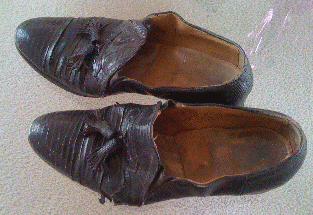 I wore those shoes for so many years I was called the Fancy-Shoes Dude! That
experience triggered something in me. And I immediately put the word out to
everyone at FGBMF (Full Gospel Businessmen Fellowship) to bring their old
clothes and shoes and the clothing ministry was born. I got the first pick of
anything my size and soon was called Mr. Fancy-Pants along with the Fancy-Shoes
Dude! So Jesus had me well-dressed from that point on.
I wore those shoes for so many years I was called the Fancy-Shoes Dude! That
experience triggered something in me. And I immediately put the word out to
everyone at FGBMF (Full Gospel Businessmen Fellowship) to bring their old
clothes and shoes and the clothing ministry was born. I got the first pick of
anything my size and soon was called Mr. Fancy-Pants along with the Fancy-Shoes
Dude! So Jesus had me well-dressed from that point on.I told the men in prison that I had their clothes in a storage unit in Anaheim. All they had to do was come to the FGBMF Breakfast meeting that was every Saturday morning. The chapter would even pay for their breakfast and then we would go over to the storage unit and get their clothes. I remember those days as FUN FUN FUN! I could write for days on stories about the men who came and picked out the good clothing I had kept for them and how it affected them. I only kept the very best for them. Everything else I passed on to the Salvation Army.
The men got blessed in so many other ways too by just being there at FGBMF meetings every week. They all ate breakfast and they all got prayed for, and some got jobs, one got a car, some were called on to give their testimonies, some were baptized by the Holy Spirit. And all the ones that lived in the area and came back every Saturday morning we made members of the group by taking up a collection to pay for it.
I became New Member Chairman and broke every record the Chapter ever had. And the one year The Full-Gospel Businessmen’s Fellowship Headquarters put on a nation-wide new members sign-up contest for all the chapters in the whole USA, I won that contest too! Those were definitely FUN FUN FUN times.
Jesus Knows Everyone's Clothing Size! Matthew 6:28-34 - By William Sultzer
After we had moved all the clothing from the storage unit into the big garage at the Garden Grove Half-way house, the Orange County Register (a California newspaper) started running articles for us about our need for every size of good men’s clothing and shoes.I got a call one day to go pick up some clothes from a man in Irvine. He said he was 6’7” tall with a size 14 shoe. And of course, he asked if I ever had anyone that big who needed clothes.
I said: “Not so far, but Jesus knows everyone’s size! So I’ll be glad to come pick them up!” It turned out that this dear man was donating his entire wardrobe because he had just gotten a promotion and they wanted him to buy all new clothes so he looked more successful.
When I got to his home I discovered he had many thousands of dollars worth of suits and sport coats, slacks and size 14 shoes, plus all the everyday clothes! He was starting his wardrobe all over, so he gave the ministry everything. The man’s wife told me about every single piece of that clothing—when it was bought, how much it cost them, on and on. She wanted to be sure I fully understood the magnitude of this offering to the ministry. One thing is for sure--that is what I remember the most as I write about this now. They were donating very expensive clothes that had cost them a lot. They were really nice people too and were enjoying being able to help God’s Kingdom out. They were visualizing someone getting out of prison that big with no clothes and no money that could buy that size of everything they were giving. And they were visualizing rightly too!
It took a couple of weeks. But you guessed it! Jesus sent us someone! He came from the Bureau of Prisons state-run work-furlough facility. As I mentioned before I helped as many of the men in that program as I could by picking them up each Sunday for the Ex- Offenders Reunion meetings and the home-cooked dinner afterward--and of course to get clothes after that. This man came with his wife that Sunday, and after the meeting and dinner, everyone at that week’s Ex-Offender’s Reunion meeting stood around spell- bound, watching this big 6’7” guy try on all these clothes I had picked up. And of course, they were exactly his size. This man’s wife was telling us in detail what had happened to all his clothes while he was in prison for just a few years and how he had gotten out with no clothing at all to come home to. Yes, and the size 14 shoes fit him perfectly too! Jesus always made preparation for the ones He sent to us by bringing to the ministry exactly what they needed. EVERY TIME. Big or small, their size was of no consequence to the Creator of the universe!
So I gave him all the clothes except for some of everything in case Jesus was sending someone else to us of the same size. If so, that way the second guy would have at least something to wear. But Jesus never did send anyone else that size. It seems like He did all this just for this one man--and were they ever grateful! The wife cried and cried and cried as they were leaving. What a wonderful day that was for all of us at the Ex- Offender’s Reunion meeting. But then too, Jesus did something similar most every week. It was one exciting miracle after another. Here is just one example.
The First Halfway House - A Miracle of the Lord - By William Sultzer
If you’ve read the story about the mystery shoes, you’ll know how I realized there was a real need for the men getting out of prison to have shoes and good clothes. That realization caused me to put the word out at the Full Gospel Businessmen’s Fellowship (FGBF) the following Saturday and the clothes and shoes started coming in the next week and continued for years! God must have really been in it, for so many clothes came in, the storage I had was soon so full of men’s clothes I could have opened another clothing store! So, in the beginning all the clothes given to the ministry by the men at FGBF [& from everyone else who wanted to donate] were kept in that modest storage unit. For the parolees to get their good clothes, I had the men come first to a FGBF Saturday breakfast meeting. And afterward I’d take them to the storage unit and let them pick out any clothes they wanted. If the men weren’t saved when they got to the fellowship, they sure were before it was over. Very few escaped the anointing of those days. That routine lasted a couple of years give or take a month or two.Then sometime in 1987 I started a halfway house in Garden Grove. That was only possible through a miracle gift of $20,000 the Lord gave me through a dear lady who ministered with me in the prisons. I went from just renting a room to renting a whole 5-bedroom house for a bunch of Christian parolees just getting out of prison. It was my first halfway house. To see details of how that all came about, see The Power of Prayer and Fasting. At that point all the clothes for the clothing ministry were moved into the double car garage, and it held a whole lot of clothes! Racks were built all along the walls and down the middle. Jesus started having clothing donated in even larger amounts! The local newspaper, The Orange County Register, did an article about the need for good men’s clothing and shoes of every size. See article on Jesus Knows Everyone's Clothing Size.
I only kept the best of everything for them, and passed the not so good ones to the Salvation Army, because they had the outlet to sell the worn out clothing by the ton to the recyclers— especially if it was made of cotton or wool.
So to keep from having parolees coming by at any time of night or day to get clothing, I started the Ex-Offenders Reunion meetings on Sunday afternoon. There were two Bureau of Prisons state-run work-furlough houses in Orange County and I started picking up those men in our van too and bringing them to the house for the meetings and home-cooked dinners afterward. We also let the Sober-Living houses know they were welcome. Plus we invited everyone from the prison we ministered at to come join us on a Sunday afternoon for the meeting, dinner and clothing afterward when they were paroled.
Although sometimes I would be left alone on a Saturday to do all the food preparations and all the setting up of the tables and chairs for Sunday diner and equipment for the Ex-Offenders Reunion meeting, usually the men that were staying there at the house would help with everything that needed to be done. There was one really special man, Jack Torrones, who was a good cook. So when he came and joined us at the halfway house that we called “on-the-way-house,” he started cooking a lot of the Sunday dinners for everyone. Jack was a man with such a big heart that he helped me with everything. I grew to really depend on him while he was there, plus my love for this talented man grew also. He was a true servant unto The Lord.
The halfway house itself was a rare older house. It had 5 bedrooms plus an office. I was so glad to have found this house. But as I remember back now, having that place put me through some of the hardest lessons I ever learned. I found out that if you want to help people, prepare to get hurt.
The men all came from one of the prisons where I ministered. It was as if they were handpicked by Jesus to teach me one lesson after another. Everyone was already a Christian and they were truly grateful to be able to be living there—FOR ABOUT TWO WEEKS! After that they wanted to tell me how to run that house! And though they all admitted they needed help, they made it clear they wanted me to help them the WAY they wanted help. So I had someone in my face ALL THE TIME. Least it seemed like it!
I didn’t want to have a big list of rules. They had just come out of that kind of atmosphere. I originally thought we could all share this house together as Christian brothers. But a list of rules got started when some guys wanted to stay up all night and sleep in the day time like they could do in prison. As each new problem arose, the list grew longer, until it ended up being 3 pages long! Each new rule was a painful lesson I learned the hard way and in some cases had cost money, like the $300 phone bill one guy racked up all by himself late at night. Ouch!
I loved these guys and really wanted to help them get started anew. Each new rule was a hard lesson learned, like I said. But when this one guy came home with a $500 car from a used car lot that he had paid $1500 for and spent ALL his money—money it had taken him many years to accumulate in prison industry working for just $.08/hour—I had to add a new rule for their protection: “everyone has to talk over a major decision before doing or buying something big.” That poor guy didn’t even have money left for insurance or gasoline--and this particular car used a lot of it! He had been down a long time and just did not think about any of this stuff, and most of them didn’t.
Then I discovered that anyone that got a job and had to work on Sundays, ended up separated from the rest of us and they were the ones that were failing and having to go back to prison. Oh how that hurt. I was taking their failure personally. So—new rule: no more Sunday jobs!
Everyone either had a job or was looking for work. And they sure were looking good with all the nice clothing Jesus was providing us. I always told them to go looking for the job dressed up. See the results of that recommendation here.
This house in Garden Grove also had an add-on enclosed patio that had all the windows toward the back. And those windows could be removed. So we removed them and put chairs on the outside of the enclosure too. Altogether we could hold 45-50 people inside and out. Other people came too to support the Ex-Offenders Reunions in one way or other, plus being able to eat for free. And those meals were really wonderful home-cooked meals. The guys were so grateful to get to eat there and looked forward to each Sunday—and for good reason! The men in the work-furlough houses didn’t get much food to eat even though the state provided it through caterers. But the caterers were just in it for the money, not for the service; so they cut every corner they could both in quality and quantity. As an example: the men’s daily lunch was baloney sandwiches with frozen baloney! The poor guys were always hungry. AND the Sober-Living people also had food problems. They had to supply all their own food, and were given ONE week to find a job. So we sent each of them home with as much food as they could carry as well. It was a joyful time once the rules got in place! Fun. Fun. Fun.
It Seemed Impossible - By William Sultzer
Each week I picked up a big black dude from the state-run work-furlough program that the California prison system ran for the men coming out of prison. The prison system was trying to let the men get used to being out of prison and giving them a chance to get jobs before going on parole. It was a really good idea, but unfortunately this much needed work-furlough program only lasted a few years.Anyway, this particular man was not only big, but also so large in the chest that although I had regular clothing for him, I did not have a suit that fit him. And he really wanted a good suit because he would soon be seeing his family for the first time in many years and wanted to look his best for them. I remember he had been in prison for 12 years eating that prison food, and the work-furlough house food was not much better. So he was really enjoying the home-cooked dinner we made every week for everyone that came. He had come a few times (I forget exactly how many) and though no suits had fit him, I told him each time that Jesus knew everyone’s size, including his!
Somewhere around maybe the 3rd or 4th week he’d been coming to find a suit, a lot of suits were donated from an expensive men’s store by the name of Silverwoods. I mean like HUNDREDS of suits! And they still had their price tags on them--$499-$1,000! So I went through all of them looking for his suit in particular and set one suit aside that looked to me would fit him. And sure enough. It did. And it was a double-breasted suit with a price tag of $1,000! That material was so amazing you didn’t even have to feel it to know how expensive it was!
As this big bad-looking dude with knife-scars on his face looked at himself in the mirror, he broke down into a deep stirring, sobbing kind of weeping. It was so out of character for someone who looked so tough, that we were all concerned and asked him: “What’s wrong? The suit fits fine and you look really great in it!”
When he got control of himself and could talk again, he said: “I accepted Jesus into my heart just a couple of weeks before I got sent to this work-furlough program and I had asked Him to take care of my needs.” He broke out into a big smile and added: “And it looks like He is going to do it in style!
It turned out his family was coming from New York the very next week and Jesus supplied him a new expensive suit just in time to be able to see them all dressed-up in the best money could buy! I've always said that the miracles of Jesus aren't just in the actual happening, but in the timing of that happening. Who could have timed that so perfectly except the God of the Universe? And through the work-furlough program he was in, he had worked hard every day for a moving company and had saved every cent he made. So he even had money in his pocket!
When he hugged me good-by that last day, he started to cry again and just could not let go! Yes, I found out from people like him and a LOT of other guys, that the Father answers EVERY SINGLE mother’s prayer for the salvation of their children! He sure did it for this man’s mother. And He sure did it for my own mother. I am so grateful I get to spend eternity with all of my family plus all the body of Christ too, like this dear brother that Father provided a perfectly fitting $1,000 suit for! And the amazing thing was that in getting him just the perfect suit, Jesus also provided expensive suits of every size and color for hundreds of other inmates who were sent to us! Yes, indeed. Jesus knows everyone's size!
God Always Answers a Mother's Prayers for the Salvation of her Children - By William Sultzer
Every week while I had the half-way houses that I called “On the Way” houses, I would pick up the men from the two California state-run work furlough houses in Orange County and take them to our Ex-Offenders Reunions with Sunday dinners included. Afterward any who needed clothing would be taken to the garage with all the great clothes that had been donated for them.There was this one small young man, not even 5’ tall, that asked if there would be any clothes his size. When I said, “yes,” he then said, “Could I just come for the clothing? I’m not into any of that church stuff.” I told him: “Sure, sure, but you have to sit with the rest of us through the meeting.” He wanted to make it known that he was not a suit-type person and was not coming to get a suit, but that he just needed some everyday clothes and shoes. I used to make every one of them that got the other clothes to take a suit too.
So he came with the rest of them. He was trying to act tough and walked with that prison “tough guy shuffle.” We were all singing praise songs to Jesus and he started crying out loud.
He looked at me and asked: “What is this?” He could not stop crying. I told him: “It’s the Holy Spirit. Just sit back and enjoy it!” To make a long story short, he accepted Jesus into his heart at the time of the invitation that I always gave at the end of the meeting.
So after when all the men who needed clothes went into the clothing room, he found some good clothing that he liked and were his size, to his surprise! (Here is another remarkable story about a 6'7" man). There was another small man there that was trying on a very expensive suit at the same time, but it was just a little too small for him. That is how we knew which suit was the right one for each man, cause they only got one, and it had to fit. This little guy who had just gotten saved was still telling everyone he was not a suit-type of person, but he must have liked the way that suit looked on this other small guy.
He could tell that it really was a very expensive suit, so on an impulse he asked if he could try the suit on since it didn’t fit the other guy and they were close to the same size. He said he just wanted to see how he would look in a suit and tie. And it fit him PERFECTLY. And while he was trying the suit on, he asked, “Did the prayer I prayed at the end of the service make me “borned again.”
We said, “It sure does.” He was looking at himself in the mirror with this expensive new suit on, and he looked very sharp. All of a sudden he started crying again. He admitted to me that he was going to see his mother the following day for the first time in years, and that she had been praying for him all those years.
He said: “She’s been praying that I would get ‘borned again.’” (He always called it “borned again.”) Then we heard him say in between sobs: “She always told me to go to the Chapel while I was in prison, but I never did. But I am going to see her now after going to church, and be able to tell her—’I am now borned again’ and I will be wearing a suit.”
He left that day walking like a normal man not swaggering like a prison tough guy as he had come in. I know that God answers every single one of a mother’s prayers for her children’s salvation. But this was one of the most dramatic changes we had witnessed. And it happened right in front of our eyes all within an afternoon.
A Note to Churches: Church Growth through Helping the Community - By William Sultzer
Every church should start a clothing ministry for the men and women getting out of prison. They should also have a food ministry for the wives and children of the inmates in prison.The wives of inmates do qualify for food stamps. And they can also get a welfare check each month and housing because their husband is in prison. The problem is, neither the welfare check or the food stamps last to the end of the month. There is always at least one week at the end where the family has nothing. And what happens to families at this point is nothing short of tragic. The wife is forced by necessity to divorce her inmate husband --regardless of how much she may love him or how good a father he may be for their kids-- and to marry someone else so she and the kids can keep eating and survive.
After all, it was the husband's fault all this has happened. And he may be facing several years in prison. The family left behind has got to survive while he's gone. So the wife divorces him and remarries someone with a job. Very often she marries one of her husband's friends, cause he is the one coming around checking on them. He also knows she is alone. When the husband in prison receives the divorce papers, he very often goes crazy behind those walls. There is nothing he can do to help her. Then to think it is not because she does not love him or would not be willing to wait, but because there is one week a month with no food and nothing to pay any bill with that comes due. And she wants to keep a roof over their heads. Oh how it hurts that poor dude (the husband). In the cases when it is one of his friends that she is marrying, it drives him crazier. If the churches just have a food ministry for these women and children, all this grief can be prevented and family units preserved. And the inmate has something to look forward to when he gets out. And if the church has a clothing ministry for these men getting out, it is also a great help in each of them finding work When they look sharp, they feel more confident about themselves. [See A Parolee's True Story] The other issue is in helping--as possible--in getting the husband assigned to a prison close enough so the family can visit him. It is a huge help not just for the inmate, but for the kids and wife too! It boosts all their spirits and makes the waiting more bearable. You will be able to bless the women and children and accept the man also into your community when he gets out. And just think of all the children you can help impact for good with the gospel of Christ and change their lives forever so they do not follow in the wrong steps of their fathers. And the fathers often find The Lord in prison and come out changed men! And if you have cared for their families, they will joyfully be part of your communities.
The 30th Anniversary of Psalm 146:7 Prison Ministries March 16, 2014 through October 2019
Even though William is now in his 80's, he is still ministering life and understanding to everyone our Father brings across his life. Right now that is two-fold. First he goes around his assisted living facility blessing and encouraging everyone he can, and ministering the life of Jesus to them. Secondly, he weekly blesses the homeless that come for meals on Sunday afternoons to the church across the parking lot from where he lives. He shares the power of Jesus Christ with them, and his own experiences dealing with ADD since he discovered the majority of the homeless are also ADD! And thus are in need of his classic self-help book about his life and his discoveries about ADD. Central to it all is the power of Jesus Christ to transform our lives and he's gotten hundreds upon hundreds of letters from inmates and x-inmates who have read the page William believes central to it all and have given their hearts to the Lord of all. So he gives books away to the homeless each weekend to each new person he discovers has ADD.However, his heart is still strongly with the ADD inmate caught in the revolving prison door of self-medicating just to function, and with the help of Tim Adams, his ministering partner, and his long time friend, Steven Lin supplying needed funds, he is now expanding into a YouTube channel with expectation of also reaching those still on the outside of prison walls so they find Christ's infinite transforming love before self-medicating and/or gang-involvement leads them any further down the path of destruction. So besides blessing the homeless that come for meals at the church, he and Tim are now digging through the many boxes of videos saved from his years of ministry & miracles with ex-inmates. And when not thus occupied, he makes the rounds through the halls of his assisted living facility, bringing the light of our Lord's Word of hope and encouragement to those in the facility with him. The stories he's told me are truly encouraging.
Below are a few of the videos you can find on the new YouTube channel:
Psalm 146.7 Ministries
Ex-founder & leader of the Mexican Mafia, Conrad Donald (Big D) Garcia
William explains the diversity of the Praisuary
From prayer to praise to prophecy
November 4, 2019 brought a shock to us all. William Sultzer went home to be with Jesus, his loving Master.
It is with deep regret I share the news that William Sultzer, GOD'S amazing evangelizing machine, passed to our FATHER'S arms on 11/4/2019, sometime in the very early morning hours ostensibly from complications from pneumonia. He was evangelizing his last roommate a day or two before his own last moments, though I don't think he knew it, he was so full of excited anticipation for the new YouTube adventure he and Tim Adams were venturing on that was launched with an interview with Conrad Garcia (Big D). Please check out the YouTube Channel link above. Our beloved William was truly one of America's unsung and least known heroes for the incredible transformations he occasioned in the lives of so so so many prisoners, not to mention the miracles that flowed through his ministry. Please check out the many miracles we recorded on this website under Articles of Interest. They reveal some of the unusual happenings in his ministry regarding prisoners. You will be fascinated. Our FATHER is still working through HIS willing vessels, regardless of background or age!Willliam's ministry partner, Tim Adams, will be continuing William's ministry through YouTube, and Tim's own revelations, and William's website will remain open and available as a legacy and as a source of encouragement to any who suffer from the challenges of ADD. There are also 2 important articles for the loved ones of an inmate getting out of prison in the Articles of Interest section. William's book: The Happy Prisoner is available to read and for free download online. For a copy of the book, email Tim Adams at Timboe13@hotmail.com
William Walter Sultzer as remembered by his loving family 2/29/1937 ~ 11/04/2019
William was born 4 days after Christmas in 1937, in Fairbury, Nebraska. He passed into the living arms of Jesus on November 4, 2019 in Fullerton, CA, after a short illness. He was the 2nd child born to Clarence & Louise Sultzer, who were both born & raised in NE. His sister,Lois was 15 months older than him & they were quite close. William, known then as Billy, was 2 years old when his parents decided to visit his Mothers family "who had headed West" to California! They loved it & decided to go back to NE & sell everything to move "West" themselves. His Gramma Sultzer was not happy at all about this event!Where they landed in CA, was great weather, quite rural, & a wonderful place to raise s family. And there was NO snow! Two more sisters were born in CA: Helen in 1940, & Marjorie in 1945. William went to school in the Garvey School system: Willard Elementary, Garvey Junior High, & he graduated from Mark Keppel High School (Alhambra, CA) in 1956. He was active in their gymnastics program & won many CIF awards in all areas! He did hand stands off anything that did not move until finally his Dad built him a solid set of bars in the yard to practice on! He spent many hours on those bars.
After the move to California, William's Dad began a dream he always had, of owning & raising horses. He used to ride his Grandfather's team of work horses, so he was very experienced with them. So William grew up riding the ponies, showing in horse shows, and riding the trails of the Rio Hondo River. When his Dad started riding in Parades throughout southern CA, William took his place in the line up of the Sultzer Family of 6, all on black & white Pinto horses. The Granddaddy of all Parades was the Pasadena Rose Parade, in Pasadena, CA. William's Dad began riding in it in 1946 & rode for 36 years until his death in 1982. He had added the family members & often there were Son~in~laws added to the line up, making 7, then 8 members in the Sultzer Family. In high school, besides the love of gymnastics, William also loved the girls! He drove a beautiful Oldsmobile which attracted many girls! His Dad owned an Auto Paint & Body Shop, so this car was perfection! It was complete with pin stripping done by the steady hand of his Dad. His Mother was a school teacher & worked nearly every night with him on his home work. At a very young age he did not see the value of school & disliked the work. His comment was always: " When will I ever need this in my life??" Back in those years, no one knew anything about ADD, learning disabilities, or anything out of the normal learning curve. Years later William would write the book on them, especially ADD that had given him so much challenge.
He attended college in San Francisco majoring in Hotel & Restaurant management. He loved to cook & had a passion for that profession. He worked summers at a wonderful resort for wealthy people from the Bay Area. It was named Hobert's & it was situated in the beautiful mountains north of San Francisco. After several years of college, he joined the Army Reserves & graduated from Boot Camp at Ft Ord in northern CA. That life really wasn't for him but he did complete his obligation to his country.
Next came the creation of his own restaurant/nightclub in Laguna Beach, CA. He named it the " Orphanage" & it was a very popular place. He wasn't really happy there, though he loved the ocean. Some college friends encouraged him to come back to San Francisco to open up a nightclub in a very busy area of the City. He opened it to great fanfare & he loved the attention from famous singers & popular known recording artists.
William married Cathy, a much younger beautiful lady that he had been going with. They were married in the nightclub in San Francisco & it was quite an event. It wasn't a simple wedding & went on for nearly 2 days! Family & friends flew in from all over the state to witness this lovely affair! Their son, William Robert Sultzer was born on February 8, 1973 & William was so delighted & so proud! He quickly realized how difficult it was to raise a baby & run a nightclub. Cathy wanted to party at night, not stay home with a baby. Little William was soon sent off to Southern CA to be raised by her parents. William flew down to see him as often as he could, but the travel was draining on Him & the business. The marriage fell apart & after the divorce, William closed The Orphanage & moved with his son to the beach area of Laguna Beach. Cathy went her own way & did not see her son much.
He first opened a clothing store that sold beach wear but his heart was still in the restaurant & nightclub world, so he opened the 2nd Orphanage in Laguna & enlisted help to care for his son. Again, the restaurant was a success & had very good food. They lived in an old home on the sand & spent lots of time in the ocean. They loved this quaint town & had many friends. Little William grew up with many adults who did not have children and quickly became the star child of many childless people & got tons of attention.
During these restaurant years, it was evident William was into "something big!" There appeared to be lots of money flowing through his life, different friends, night time visits by strange people, & many secret phone calls late into the night. His energy level would spike, & one could hardly communicate with him. He lost his lease so had to close the restaurant for the 2nd time. Then it seemed he was " always on the run," always moving: Lake Tahoe, Big Bear, you name it, & he was never calm! The one constant in his life was his son, who was too young to know what was going on. He was also growing up with out family life & rarely getting to see his Mother.
William approached Marjorie, his youngest sister, who had just been divorced by her husband, to move to Big Bear, CA. He needed help running the many cabins on the property that he rented to tourists. She accepted the offer & moved with her 3 children to the Mtns. She included Little William in her family as his Dad was away a lot of the time. She worked hard, & they all learned to ski & hike the beautiful area around Big Bear Lake. She was happy, although troubled about what her brother was doing. She says even to this day that this experience was when she finally got to know him as her real brother & who he really was.
Soon he was really "on the run!" He finally turned himself into the Reno Sheriff's station as he was very close to being caught. No one knew what was going on but he was soon arrested for being a Cocaine Drug smuggler & his "run" was over. His parents & family were devastated! He was sentenced to 7 years in prison. This drastic news hit his Dad so hard he developed heart problems & died while his son was in prison. He was only 72 years old & again the family was totally heartbroken. His Mother kept praying for her son & her grandson, but she was also very heart sick over the upheaval in her life.
In the meantime, Marjorie moved down from the mountains as that property was confiscated by the police. She had to give up Little William to his mother's parents--an "innocent victim" of a life gone array by his father. A very sad event in his young life! At 6 years old, Little William was sent to Arizona to be raised by his Aunt Helen & Uncle Gary & their 2 children. Aunt Marjorie had moved to AZ earlier so she was close by with her children.
William spent 5 years of his sentence, first in a Texas Prison, where "The devil was alive & well" & he was moved to the high desert of CA. The Lord finally got through to this man in that cold dangerous prison in TX. His Mothers prayers were answered as he gave his life back to Jesus & dedicated his future to Him. He vowed that someday he would help the men coming out of prison. Most of these men did not know why they keep returning to the place they hated so much or even what was wrong with them. William researched the "why" & how to fix it. He studied for years as he had nothing but time on his hands. He was released from prison about 1986 & immediately formed his prison ministry he named: "Psalms 146:7 Prison Ministry." This Ministry became known for the help people could go to for clothing, a place to live, help with resumes, encouragement, etc., and most of all, a place so full of Jesus that multiplied hundreds of released prisoners and others found the Savior for themselves and it transformed their lives, etc.
He began writing the book that had swirled around in his head & heart for years. In it he told his story, and taught about the ADD issue in his & most prisoner's lives and helped them understand it and how to cope with it. He named his book: "The Happy Prisoner" & took it to prisons in the Chino, CA area. He carried them everywhere he went & told everyone he met about this book. The research he did on ADD made a huge difference in his life. He changed the meaning of "ADD" to "A Divine Difference!" Wardens read it & saw themselves in it. The prison staff read it & many saw themselves too. The prisoners read it & their families asked for more books. Only a small number could be printed as William had little money to print larger numbers that would be cheaper.
He gave the books away & he received multitudes of letters from the inmates and ex-inmates who had read his book. He was high on his mission to helping those coming out of Prison. It wasn't long into his prison visitations that he requested & received permission to book Christian singers & bands into the Chino State Prison system. Listening to music was a God-send for these men but at first they didn't want to hear a sermon. But it wasn't long before their hearts melted with the love of Jesus growing in their souls.
The Ministry is alive & well today due to the many who gave their hearts & lives to Jesus. William was at peace that his passing would not stop the fire that he started so many years ago when God dealt with him on that cold floor in a Texas Prison and that led to the writing of The Happy Prisoner and a life full of miraculous happenings in his own life and those he ministered to! The stories above are examples of some of these amazing modern day miracles!
 The Happy Prisoner